
Drain Snaking vs. Hydro Jetting: What’s the Difference?
When a drain won’t clear, two professional methods come up again and again: drain snaking and hydro jetting. They solve different problems in different ways, and choosing the right one matters — for your pipes, your wallet, and how long the fix lasts. Here’s an honest comparison.
How Drain Snaking Works
Drain snaking uses a flexible steel cable with a cutting or boring head. The technician feeds it into the pipe, rotates it, and drives it through the blockage. The head breaks the clog apart, bores a path through it, or hooks debris so it can be retrieved.
Best for: single, localized blockages — a wad of hair in a shower drain, food buildup in a kitchen line, a foreign object lodged in a pipe, or tree roots that have entered through a joint in a sewer line.
Think of it this way: snaking punches a hole through the problem. It restores flow quickly and is the right first step for most clogs.
How Hydro Jetting Works
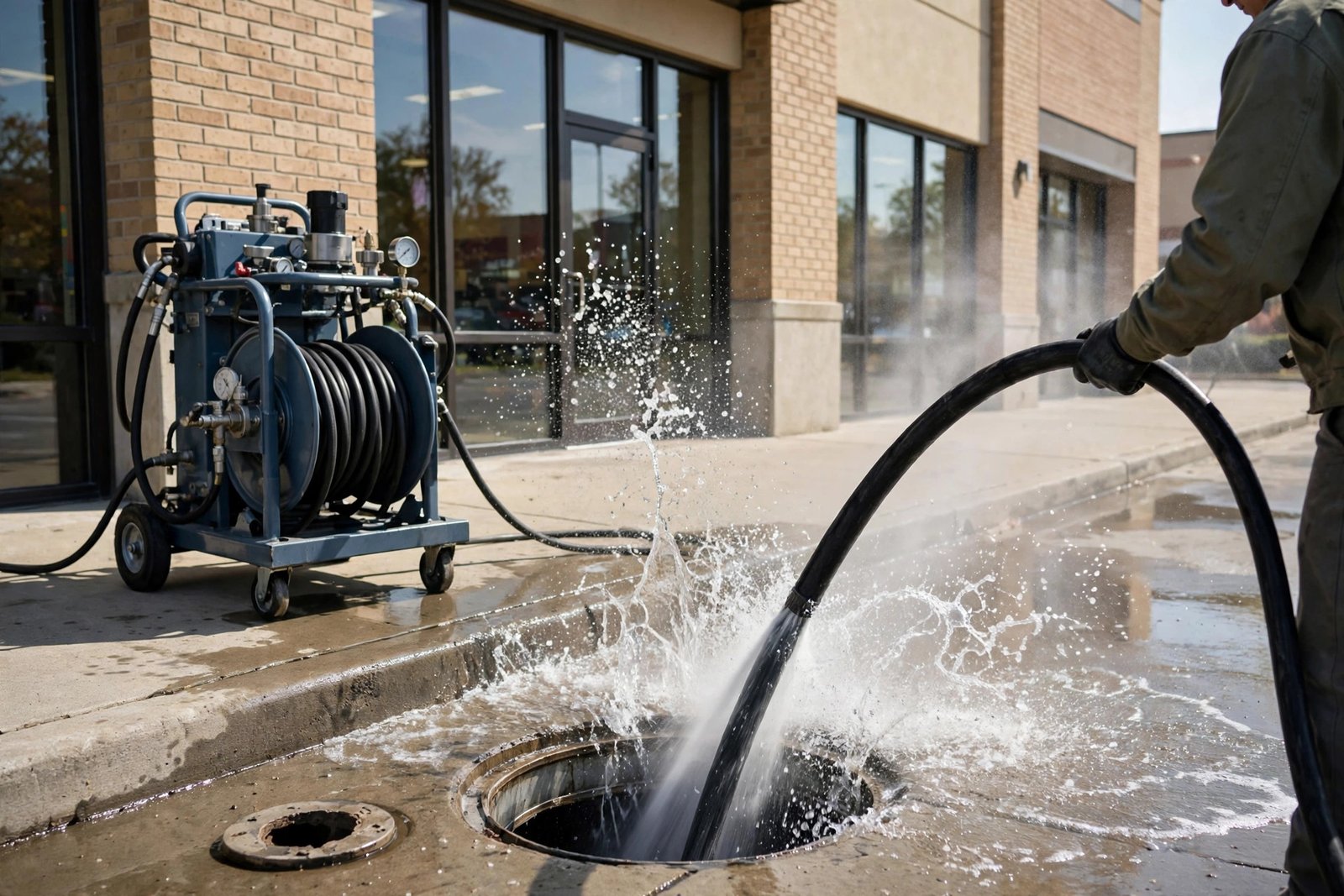
Hydro jetting uses a specialized hose with a nozzle that blasts water at very high pressure — typically 1,500 to 4,000 PSI — inside the pipe. The water scours the entire interior surface of the pipe, flushing out everything in its path.
Best for: widespread buildup rather than a single blockage — years of grease coating a restaurant or kitchen line, mineral scale narrowing a pipe, sludge and sediment in a main sewer line, or heavy root intrusion after initial cutting.
Think of it this way: jetting pressure-washes the inside of the pipe. It doesn’t just open a path — it cleans the pipe walls.
Side-by-Side Comparison
| Drain Snaking | Hydro Jetting | |
|---|---|---|
| Method | Rotating steel cable | High-pressure water |
| Best for | Localized clogs | Heavy, widespread buildup |
| Pipe cleaning | Opens a path through the blockage | Scours the full pipe interior |
| Typical duration | 30 min – 2 hours | 1 – 3 hours |
| Relative cost | Generally the less intensive (and less costly) option | More equipment-intensive; typically costs more |
| Risk to fragile pipes | Low with proper technique | Higher — requires sound pipes |
When Snaking Is the Right Choice
For most residential clogs, snaking is where you start. It’s effective, efficient, and appropriate for the majority of blockages homeowners encounter. If a technician recommends jetting for a simple hair clog in a shower drain, that’s worth questioning — snaking would almost certainly do the job.
When Hydro Jetting Makes Sense
Jetting earns its place when snaking keeps providing only temporary relief. Classic examples: a kitchen drain that clogs every few months because grease has narrowed the whole line, or a main sewer line with heavy scale that a snake punches through but doesn’t remove. In those cases, cleaning the full pipe interior addresses the cause, not just the symptom.
One important note: hydro jetting requires pipes in reasonably sound condition. High-pressure water and fragile, corroded, or already-cracked pipes are a bad combination. A responsible technician will assess pipe condition — often with a camera inspection — before recommending jetting. If someone suggests jetting an old clay or Orangeburg line without looking inside first, get a second opinion.
Can They Be Used Together?
Yes — and this is common on tough main-line jobs. A typical sequence: snake first to break through the immediate blockage and restore flow, then jet to clean the line thoroughly, then run a camera to verify the result and check pipe condition. Each step has a purpose, and a good technician will explain why each is (or isn’t) needed for your situation rather than bundling everything by default.
What About Cost?
We don’t publish fixed prices because every job differs, but it’s fair to say snaking is generally the less expensive option — it uses simpler equipment and takes less time. Jetting involves specialized high-pressure equipment and more labor. The honest guidance: don’t choose based on price alone. Paying for snaking three times for a problem that one jetting would solve isn’t a bargain. Ask the technician to explain why they’re recommending one method over the other.
Three Real-World Scenarios
Scenario 1: The slow shower drain. Hair and soap have formed a mass just past the drain. A plunger didn’t help. This is a textbook snaking job — a cable with the right head clears it in under an hour. Jetting here would be overkill.
Scenario 2: The kitchen sink that clogs every two months. You’ve had it snaked twice and it keeps coming back. The pattern screams grease buildup coating the line, not a single blockage. A camera inspection confirms narrowed, coated pipe walls — and hydro jetting scours them clean, breaking the cycle.
Scenario 3: Sewage backing up in the basement shower. Multiple fixtures affected, foul odors — this is a main-line problem. The right move is snaking to restore flow immediately, then a camera inspection to identify the cause (roots, belly, break), and then a decision about jetting or repair based on what the camera shows. Skipping straight to jetting without knowing the pipe’s condition would be reckless.
Questions to Ask Before You Approve the Work
Whether a technician recommends snaking or jetting, these questions keep the process honest:
- What makes you recommend this method for my specific problem? You want a cause-based answer, not a generic one.
- Have you seen inside the pipe? For recurring or main-line issues, a camera inspection before jetting is just good practice.
- What are my pipes made of, and are they sound enough for this? Especially important before hydro jetting older lines.
- What happens if this doesn’t solve it? Understanding the next step upfront prevents surprise upsells later.
- What affects the final cost? Get the cost factors explained before work begins.
A technician who welcomes these questions is usually one you can trust.
The Bottom Line for Newark Homeowners
- One clogged fixture, first occurrence? Snaking is almost certainly the answer. Drain Snaking Service in Newark, CA | Drain Snaking Newark
- Recurring clogs in the same line? Ask whether buildup is the real issue — jetting may be warranted. Hydro Jetting in Newark, CA | Drain Snaking Newark
- Whole-house symptoms or sewage backup? Start with an assessment and likely a camera inspection to see what’s actually in the line. Main Sewer Line Cleaning in Newark, CA | Drain Snaking Newark
Still unsure which your situation calls for? Call (510) 570-1666 — we’ll ask about your symptoms and give you a straight answer. We’re available 24/7 in Newark, CA.


3 Comments